

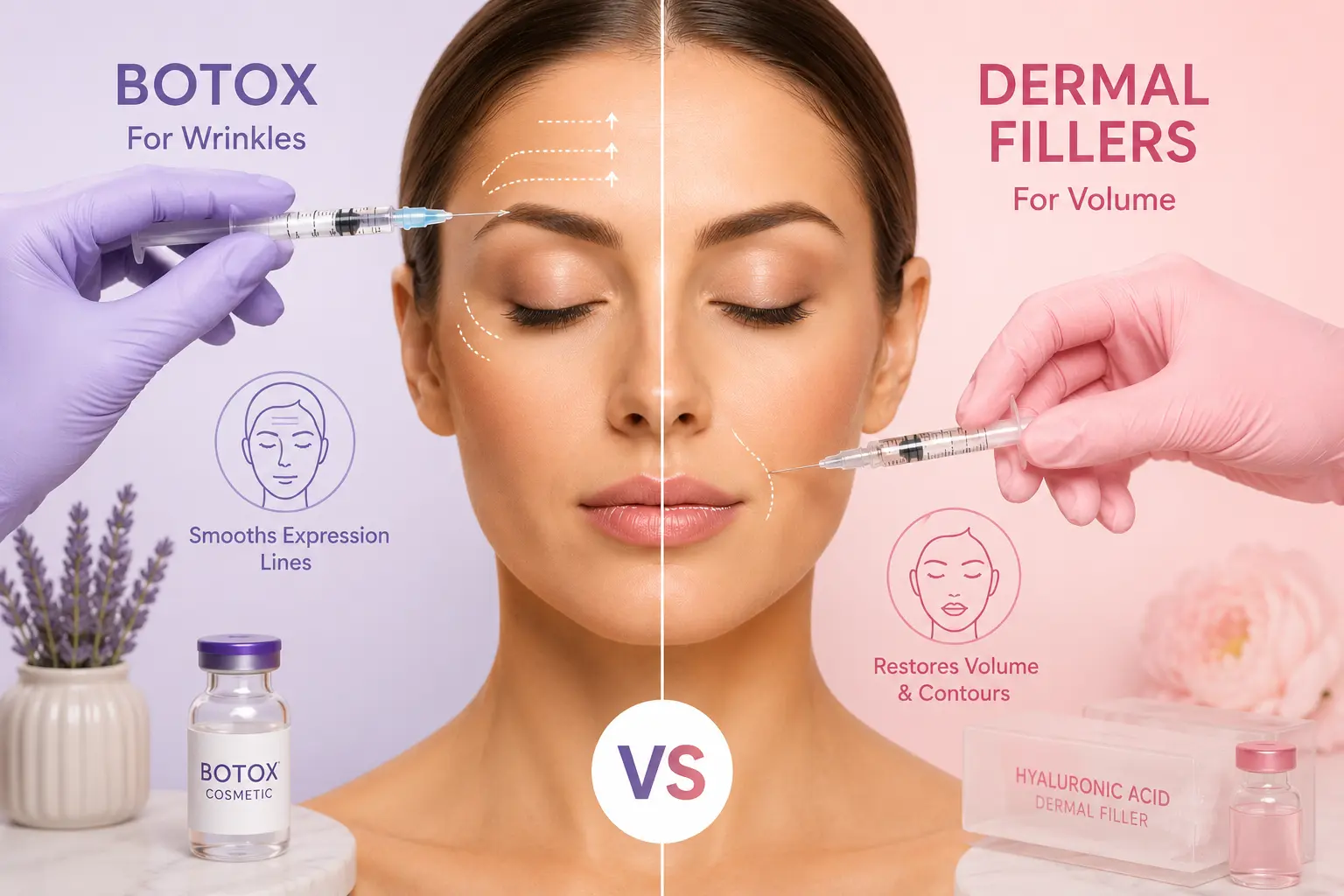
When you start noticing fine lines, wrinkles, lost facial volume, or changes in your lips and cheeks, you may wonder which cosmetic treatment is right for you. Botox vs dermal fillers is not necessarily a choice between two competing treatments. Botox and fillers address different aspects of facial aging, and the better option depends on what you want to improve.
Botox is primarily used to temporarily relax specific facial muscles that contribute to expression lines. Dermal fillers, on the other hand, add volume beneath the skin to restore or enhance facial contours. Understanding this distinction can make it easier to choose a treatment that fits your goals.
For patients considering Botox and fillers in Colleyville, TX, an individualized consultation is an important step. Your provider can evaluate your facial anatomy, the type of lines or volume loss you have, and the type of result you want to achieve.
What Is the Difference Between Botox and Fillers?
The simplest way to understand the difference between Botox and fillers is to look at what each treatment does beneath the skin.
Botox is a neuromodulator. It works by temporarily reducing the nerve signals that tell targeted muscles to contract. When those muscles relax, certain expression-related wrinkles become less noticeable. The American Academy of Dermatology reports that botulinum toxin treatment can make fine lines and wrinkles appear less visible and generally lasts about three to four months, although results can sometimes last longer.
Dermal fillers work differently. Instead of relaxing muscles, fillers are injected beneath the skin to restore or add volume. Depending on the product and treatment area, fillers may be used to enhance the lips, improve facial contours, soften certain creases, or restore volume lost with age.
This is why comparing Botox and fillers strictly as alternatives can be misleading. One primarily changes muscle activity, while the other changes volume and contour.
Botox for Wrinkles vs Filler for Volume
The question of Botox for wrinkles vs filler for volume is one of the most useful ways to determine which treatment may fit your concerns.
Botox is typically best suited to dynamic wrinkles. These are lines that become more visible when you make facial expressions. Common treatment areas include the forehead, the vertical lines between the eyebrows, and crow’s feet around the eyes.
For example, repeatedly raising your eyebrows or squinting can cause expression lines to become increasingly noticeable. Botox can temporarily reduce the muscle activity responsible for those lines, resulting in a smoother appearance.
Dermal fillers are generally better suited to concerns involving volume loss or changes in facial contour. Depending on the product and treatment plan, fillers may be used in areas such as the cheeks, lips, chin, and certain facial creases.
A person with prominent forehead lines may benefit more from Botox, while someone experiencing hollow cheeks or decreased lip volume may be a better candidate for filler. In some cases, both concerns exist at the same time.
When Might Botox Be the Better Choice?
Botox may be appropriate when your primary concern is movement-related wrinkling rather than a lack of volume.
You may want to discuss Botox with a qualified provider if you are concerned about:
- Forehead expression lines
- Frown lines between the eyebrows
- Crow’s feet
- Wrinkles that become more prominent with facial expressions
- A desire for a smoother, refreshed appearance without adding facial volume
The goal is not necessarily to eliminate every facial movement. Appropriate treatment should be tailored to your anatomy and desired appearance. Dermatologists generally aim to relax targeted muscles while preserving natural facial expression.
Botox treatments are also relatively quick, with the injection portion often taking only a short amount of time. Results develop gradually rather than appearing instantly.
When Might Dermal Fillers Be the Better Choice?
Fillers may be more appropriate when volume loss or facial contour is the primary concern.
Aging naturally changes facial structure. Loss of subcutaneous volume can contribute to flatter cheeks, changes around the mouth, and other contour changes. Dermal fillers can be used to replace or enhance volume in selected areas.
Depending on your treatment plan, filler may be considered for:
- Lip enhancement or restoration
- Reduced cheek volume
- Certain facial creases
- Chin or facial contouring
- Areas where volume loss contributes to an aged or tired appearance
Most fillers produce visible results relatively quickly, although swelling can temporarily affect the final appearance. The exact result and recovery period depend on the product, injection site, and individual patient.
Natural-looking results depend heavily on choosing an appropriate product and using a conservative, anatomy-based treatment approach. The American Academy of Dermatology specifically advises patients to prioritize qualified medical professionals with experience performing filler injections.
Which Lasts Longer: Botox or Filler?
One of the most common questions patients ask is, which lasts longer Botox or filler?
There is no single answer because longevity depends on the specific treatment, product, injection area, and individual factors.
Botulinum toxin results commonly last around three to four months.
Dermal filler longevity varies much more widely. The American Academy of Dermatology notes that hyaluronic acid fillers commonly last approximately four to 12 months, while some other types of fillers can last considerably longer. The American Society of Plastic Surgeons also notes that some filler treatments can last from several months to several years depending on the filler and the individual receiving it.
Therefore, it is generally inaccurate to say that every filler lasts a specific number of months or that one injectable is always longer-lasting than another.
During a consultation, ask about the exact product being recommended, the treatment area, expected longevity, and the maintenance schedule you may need.
Can You Combine Botox and Fillers?
Yes, can you combine Botox and fillers is a common question because the treatments address different concerns.
A combination approach may make sense when a patient has both dynamic wrinkles and volume loss. For example, Botox may be used to address forehead or frown lines while filler is considered for an area where volume has diminished.
The advantage of combining treatments is that each can address a different component of facial aging. Rather than attempting to use filler for a problem caused primarily by muscle movement—or Botox for a concern related primarily to volume loss—the treatment plan can be designed around the underlying cause.
However, combining injectables should not automatically mean using more product. The goal should be an appropriately balanced result based on your facial anatomy and cosmetic objectives.
The FDA notes that dermal filler injections have potential complications, including infection, nodules, tissue injury, and, rarely, vascular complications that can result in serious outcomes such as vision abnormalities or stroke. Because of these risks, injectable treatments should be performed by appropriately trained medical professionals using approved products for appropriate indications.
What Should Colleyville Patients Consider Before Treatment?
Choosing between Botox and filler should involve more than identifying a treatment that looks appealing on social media. Your provider should evaluate the location and type of wrinkles, facial proportions, skin condition, volume distribution, and your desired degree of correction.
It is also important to discuss your medical history, medications, allergies, previous cosmetic treatments, and any active skin conditions before receiving injectable treatment.
For dermal fillers in particular, the injection is a medical procedure and should not be performed in a non-medical setting such as a party, salon, or private home. The AAD recommends seeing a physician with appropriate expertise in filler injections.
Patients interested in aesthetic treatments can explore the available medspa services to understand the broader range of options available.
How to Get Started With Botox and Fillers in Colleyville, TX
There is no universal Botox-versus-filler answer because every face ages differently. The right approach depends on whether your primary concern is muscle-related wrinkles, volume loss, facial contour, or a combination of concerns.
For patients researching Botox and fillers in Colleyville, TX, a consultation provides an opportunity to discuss your goals and determine whether Botox, dermal fillers, another treatment, or a combination approach is appropriate.
You can explore Glo & Glam to learn more about available aesthetic services. You can also view locations and review current specials before scheduling.
If you are interested in addressing additional skin concerns beyond injectables, explore the available laser treatments and discuss which options may complement your overall aesthetic goals.
For patients concerned about the cost of treatment, financing options may also be available, depending on eligibility and the services selected.
FAQs
Is Botox better than dermal filler?
Neither treatment is universally better. Botox and dermal fillers work in different ways and are designed for different concerns. Botox primarily reduces targeted muscle activity to soften dynamic wrinkles, while fillers restore or add volume. The appropriate option depends on your facial anatomy and treatment goals.
What is the difference between Botox and fillers?
Botox temporarily relaxes targeted facial muscles to reduce the appearance of expression-related lines. Dermal fillers are injected beneath the skin to restore or enhance volume and contour. Because they address different causes of facial aging, some patients may benefit from either one, while others may benefit from both.
Which lasts longer, Botox or filler?
Botox commonly lasts about three to four months. Filler longevity varies by product and treatment area, with some fillers lasting several months to multiple years. Hyaluronic acid fillers commonly last around four to 12 months, according to the American Academy of Dermatology.
Can you combine Botox and dermal fillers?
Yes. Botox and fillers may be used together when a patient has both dynamic wrinkles and volume loss. Combining them can allow each treatment to address a different concern. Your provider should determine whether combination treatment is appropriate based on your anatomy, goals, and overall treatment plan.
Are dermal fillers safe?
Dermal fillers are medical treatments and have potential risks, including swelling, bruising, infection, lumps, and other complications. Rare but serious complications can occur if filler unintentionally enters a blood vessel. Choosing an appropriately trained medical provider is an important part of reducing risk.
Will Botox or fillers make me look unnatural?
Cosmetic injectables do not inherently produce an unnatural appearance. Results depend on factors such as treatment planning, product selection, injection technique, amount used, and the patient’s anatomy. A conservative approach can help maintain facial balance and natural expression.
How do I know whether I need Botox or filler?
Start with the specific concern you want to change. If the issue is primarily expression-related wrinkles, Botox may be appropriate. If the concern involves lost volume or facial contour, filler may be considered. A professional evaluation can determine which approach is most suitable and whether a combination treatment would provide a more balanced result.